
Growth on growth
Simple growth earns only on the original amount. Compound growth earns on the original amount and on everything it has already earned. Year one looks almost identical. Year thirty does not.
$10,000 at a hypothetical 5% a year:
| Years | Simple growth | Compound growth |
|---|---|---|
| 10 | $15,000 | $16,289 |
| 20 | $20,000 | $26,533 |
| 30 | $25,000 | $43,219 |
Rates in this lesson are illustrations only. They are not predictions of what any savings or investment will return. Real returns vary and investments can fall in value.
Three levers
Compound growth depends on three things:
- Amount: how much you put in.
- Rate: how fast it grows.
- Time: how long it is left.
Of the three, time is the one most people underestimate, because its effect is back-loaded: most of the growth happens in the later years.
Regular contributions
Most people do not invest one lump sum; they save monthly. $200 a month at a hypothetical 5%:
| Years | Total contributed | Value | Growth |
|---|---|---|---|
| 10 | $24,000 | $31,056 | $7,056 |
| 20 | $48,000 | $82,207 | $34,207 |
| 30 | $72,000 | $166,452 | $94,452 |
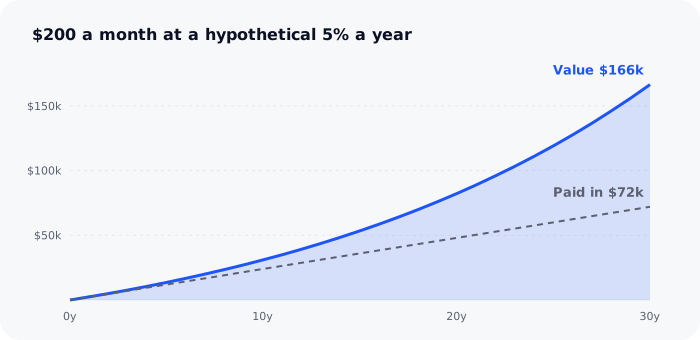
In the last ten years alone, the value roughly doubles, though only $24,000 more was contributed.
Starting early vs starting big
Two people each save $200 a month at the same hypothetical 5% until age 65:
| Starts at | Years saving | Contributed | Value at 65 | |
|---|---|---|---|---|
| Person A | 25 | 40 | $96,000 | $305,204 |
| Person B | 35 | 30 | $72,000 | $166,452 |
Person A contributed $24,000 more but ends with about $139,000 more. The extra ten years at the start did most of the work.
The lesson is not "you are too late". It is "the best time to start is as early as you can, at whatever size you can".
The rule of 72
A quick way to estimate doubling time: 72 ÷ yearly rate ≈ years to double.
| Rate | Years to double (approx.) |
|---|---|
| 3% | 24 |
| 6% | 12 |
| 9% | 8 |
| 24% | 3 |
Compounding works on debt too
The same maths that grows savings grows debt. A card balance at 24% APR left unpaid roughly doubles in about three years. This is why, in many situations, people prioritise clearing high-interest debt: avoiding a high rate of compounding against you is a guaranteed effect, while returns on savings are not.
Summary
- Compound growth earns on previous growth; the effect builds over time.
- Amount, rate and time are the three levers; time is the most underestimated.
- Starting earlier often matters more than starting bigger.
- 72 ÷ rate ≈ doubling time, for savings and for debt.
This lesson is general education. It is not investment or financial advice, and it does not recommend any product.
Key terms
- Compound growth
- Growth earned on previous growth as well as on the original amount.
- Rate of return
- The percentage an amount grows by over a period, usually expressed per year.
- Rule of 72
- A shortcut: 72 divided by the yearly rate gives roughly how many years an amount takes to double.
- Time horizon
- How long money is left to grow before it is needed.
Your turn
Run your own numbers
Lesson quiz
5 questions · pass with 4 correct1. What makes compound growth different from simple growth?
2. Using the rule of 72, roughly how long does an amount take to double at 6% a year?
3. In the lesson's example, $200 a month for 30 years at a hypothetical 5% grows to about how much?
4. Why does starting ten years earlier make such a difference?
5. How does compounding work on a credit card balance at 24%?